- May 8, 2026
- admin
- 0
The hatchability of chicken eggs significantly depends on a critical factor – the incubation temperature setpoints. While, in theory, the optimal eggshell temperature during incubation is 100°F (37.8°C), achieving and maintaining this is far from a straightforward task. This article describes the fundamental impact of eggshell temperature and how hatchery managers can effectively manage the incubation temperature to ensure optimal results.
To effectively manage incubation temperature, it is essential to understand the relationships between the air temperature measured by the temperature sensor in the incubator, the eggshell temperature measured on the eggshell surface, and the embryo temperature. In this article, the relationship between air temperature and eggshell temperature is explained in more detail.
Eggshell temperature is commonly agreed to be a reference for embryo temperature, because measuring the exact embryo temperature is very difficult and always invasive. It involves making a small hole in the eggshell to access the embryo. Measuring the eggshell temperatureis the next best method as it is non-invasive to the eggshell and embryo.
Eggshell temperature is often measured using infrared thermometres or temperature sensors that are attached to the eggshell. There are, however, slight differences between the core temperature of the embryo and the eggshell temperature. These temperature differences depend on the metabolic heat production of the embryo, the phase of development and the microclimate surrounding the eggshell.
Be aware that several devices and techniques are available to measure eggshell temperature, and there are considerable differences in measurement due to variations in measurement methods and accuracy. Furthermore, embryo temperature and eggshell temperatureare usually measured using different sensors, which also contributes to measuring errors. In practice, a lack of awareness of the relationship between embryo temperature and eggshell temperature, as well as the measuring differences between eggshell temperature devices, often results in considerable under or overestimation of the eggshell temperature.
Correctly measure eggshell temperature
A well-known and commonly used device for measuring eggshell temperature is the Braun ThermoScan, an infrared ear thermometre designed for human use (photo). Essential to know with this device is that, in the endothermic phase of incubation (before day 12), it measures around 0.4 to 0.5⁰F too high compared to the actual embryo temperature. A correction must therefore be made for this in the incubation programme. If in doubt, please consult your incubator manufacturer for guidance.
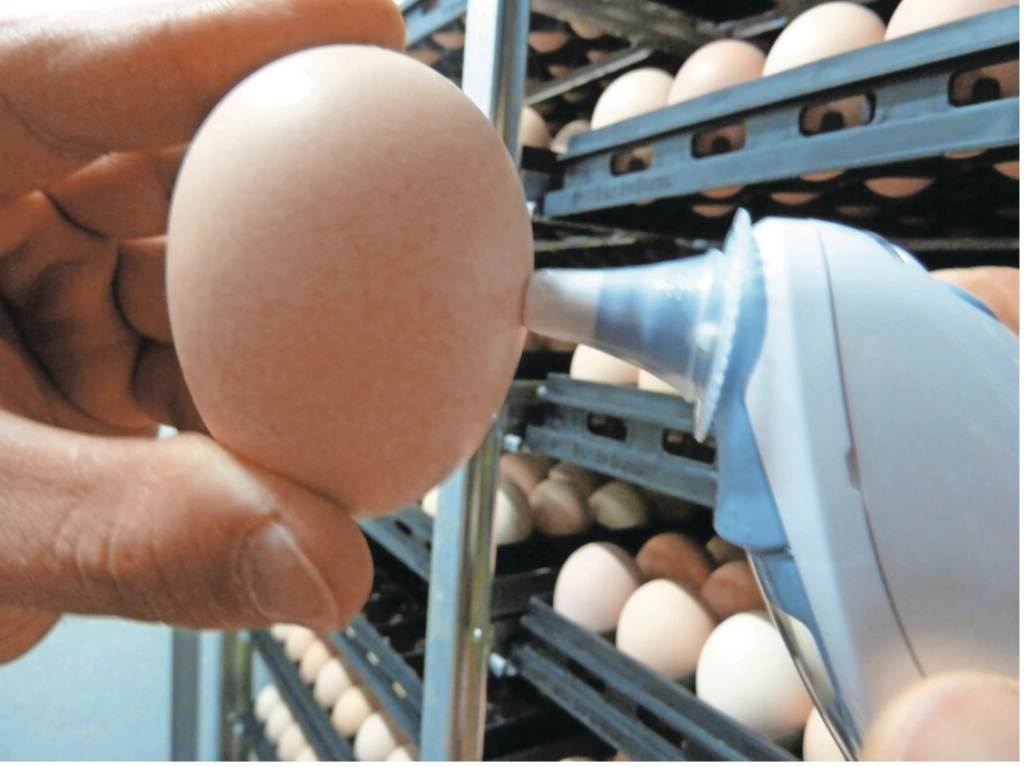
Correctly measuring the eggshell temperature sensor at the equator or the shoulder of the eggs and making complete contact with the eggshell. Photo: Pas Reform
Besides the Braun, various data loggers are used in the field and are becoming increasingly common as they provide continuous measurements in an undisturbed incubation climate. One of the downsides of the Braun is that it is not possible to measure in an undisturbed climate, as it requires turning off and entering the incubator, and possibly even removing trolleys, which alters the airflow and temperature.
Also, when measuring with any device, ensure that the measurement is taken on the equator of the egg to avoid measuring the air cell, as this will result in an underestimation of the actual eggshell temperature, especially during the exothermic phase. It is also a good habit to bring a small flashlight with you when entering a setter or hatcher to measure eggshell temperature, as you can then check for infertile eggs or early deaths. Another good habit is to measure at different places inside an incubator, at known hot or cold spots.
Switching incubation profiles is unwise
The temperature difference between the air temperature at the sensor and the eggshell temperature and embryo temperature varies between incubator types and brands. It is determined mainly by the air speed over the eggs, the position of the temperature sensor, and the developmental stage of the embryos. In general, the greater the air speed, the smaller the temperature difference between the air and the eggshell temperature.
Each incubator manufacturer recommends specific incubation programmes best suited to their incubator design, taking into account the temperature difference between the air surrounding the eggs and the temperature at the sensor. Switching temperature settings (also called incubation profiles or programmes) between incubator brands is therefore unwise.
Biological variation
The next consideration is biological variations, as these can pose even greater challenges to the hatchery manager than technical variations. Ignoring the differences in incubator design, the main reason for the temperature difference between air and the eggshell temperature is that the embryos start to produce exponentially more metabolic heat after 13 days of incubation. This means that the incubator’s air temperature must be lowered accordingly to maintain the eggshell temperature at 100⁰F.
The metabolic heat produced by embryos depends on egg weight, genetics and fertility rates. Therefore, egg batch and breed-specific incubation profiles are necessary to account for these deviations in the heat load. Additionally, some breeds are more susceptible to overheating than others. One reason for this is differences in eggshell conductance, which influences the embryo’s uptake of oxygen and, therefore, its capacity to cope with temperatures higher than 100°F.
Deviations from 100⁰F
Many scientific studies support the importance of maintaining an eggshell temperature of 100°F throughout all the phases of embryonic development (differentiation, growth and maturation). However, the embryos can handle minor (short-term) variations without significant damage. Long-term deviations from this eggshell temperature result in reduced hatchability and chick quality, where ‘long-term’ can be defined as more than 6 hours, depending on the magnitude of deviation from the optimal eggshell temperature. The underlying mechanism can be primarily explained by the availability of nutrients in the egg, combined with oxygen uptake.
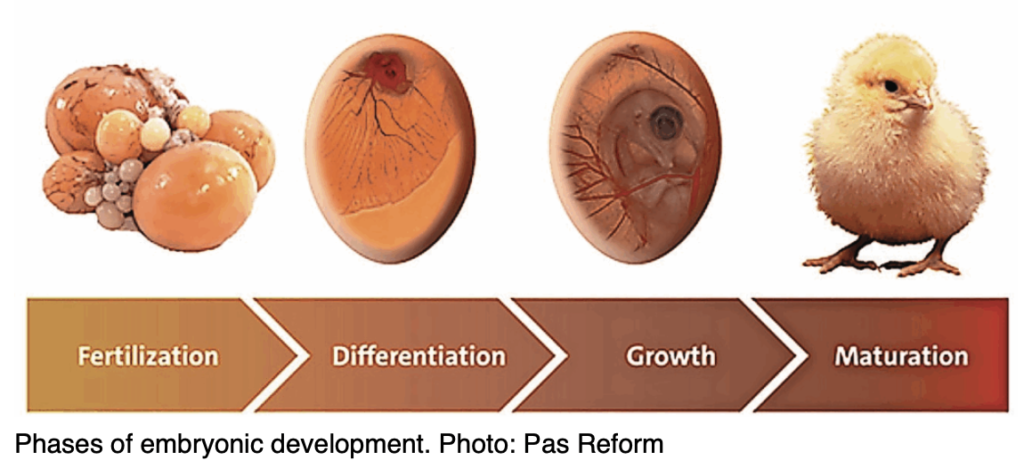
During the differentiation and growth phases, the speed of embryonic growth and metabolism largely depends on temperature. Temperature uniformity in the incubator is crucial during these stages for creating a narrow hatch window. To be able to grow and develop, the embryo relies heavily on the oxidation of yolk lipids to meet its energy demand. The chorioallantois membrane (CAM) supplies the oxygen. However, until the CAM is sufficiently developed to meet the demand, the embryo relies on anaerobic glycolysis of carbohydrates as an energy source, which are present in the egg in a limited amount and are depleted after the first week of incubation.
At around day 16 of incubation, marked by the transition from the growth to the maturation phase, the embryo reaches the plateau phase. This means that the embryo has reached its maximum potential for oxygen uptake. If the embryo is exposed to overheating, its oxygen requirement increases, and it must use less oxygen-demanding energy sources. First, it will tap into the glycogen reserves that it has built up (which have limited availability and are needed to complete the energy-demanding hatching process), and second, it will tap into protein from the muscles. However, using these alternative energy sources has a negative impact on hatchability and chick quality.
ALSO READ: Is South Africa the second most competitive poultry producer in the world?
The maximum oxygen uptake through the CAM is determined by its vascularisation and the eggshell conductance. In turn, the eggshell’s conductance depends on the structure and density of the pores, as well as the shell thickness. If the eggshell conductance is lower, the embryo will reach the maximum oxygen uptake sooner and consequently be more sensitive to a high eggshell temperature (> 102°F). Prolonged exposure to a high eggshell temperature leads to lower organ weights, such as smaller hearts, and more chicks hatching with poorly closed navels, thick bellies, and lower yolk-free body mass as the embryo could not fully utilise the yolk lipids. The level of late embryonic mortality will be higher, and a characteristic symptom during an egg breakout will be a higher incidence of malpositioning (head over wing). Farm performance can also decrease, through increased mortality, a higher feed conversion ratio and greater disease susceptibility, for example, to ascites.
While the mechanisms behind a high eggshell temperature are beginning to unravel, the effects of a low eggshell temperature remain unclear. Prolonged periods of low eggshell temperatures (<100⁰F) certainly slow down development due to the poikilothermic nature of the embryo. If pulling time is not corrected accordingly, this leads to lower hatchability. The precise mechanisms of low eggshell temperature and their consequences on chick quality, especially robustness and farm performance, have not been as intensively studied as those of high eggshell temperature; however, scientific evidence suggests that it positively influences organ development. Notably, strategic short-term temperature deviations (a couple of hours higher or lower than 100⁰F) during specific stages of embryonic development have shown potential positive effects on chick robustness.
Managing biological and technological imperfections
Even within a batch of eggs from the same origin, there are biological differences, such as weight differences, that cause one egg to produce more metabolic heat than the other. Given that there are differences in air speed inside every incubator, it is not surprising to see small deviations in eggshell temperature.
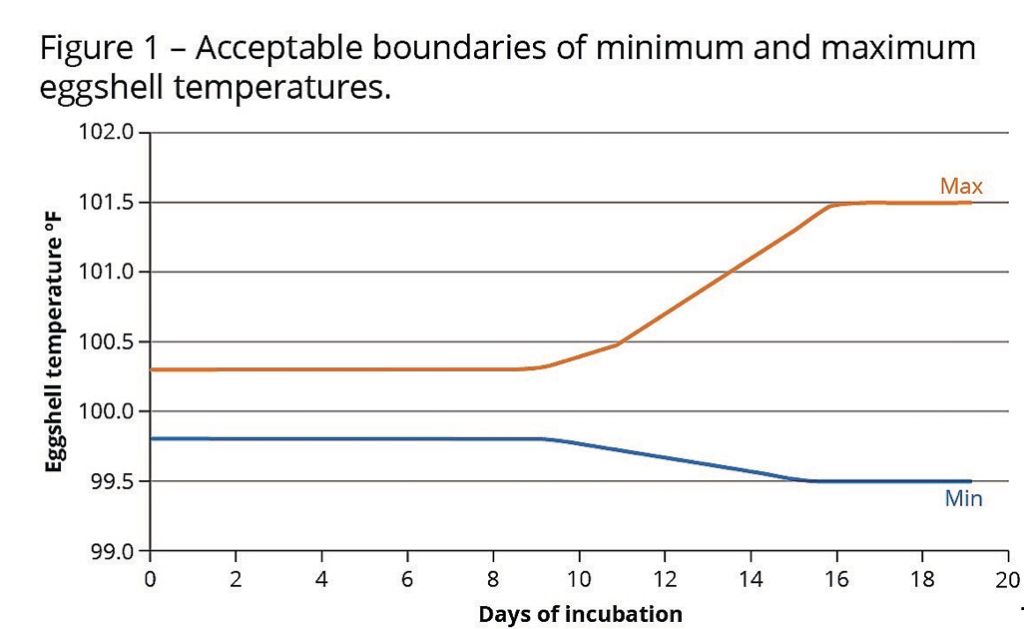
The acceptable range of eggshell temperature uniformity is shown in Figure 1. To minimise differences in eggshell temperature and therefore make hatch results more predictable, hatchery managers can embed Standard Operating Procedures (SOP) and make strategic choices in the daily hatchery routine (see box).
Maintaining an optimal eggshell temperature is crucial for the success of poultry hatcheries. Scientific evidence supports the importance of a constant eggshell temperature of 100°F throughout the incubation process. However, achieving this in practice is challenging due to differences in incubator design, variations in the heat load produced by eggs, and varying egg characteristics.
To overcome these challenges, hatchery managers can adopt practical measures that include regular eggshell temperature monitoring, ensuring uniform temperature distribution through proper incubator maintenance, strategic egg placement, and aiming for a uniform heat load. By using these guidelines, hatchery managers can optimise hatch results, improve chick quality and, ultimately, enhance the overall performance and profitability of their hatchery operations.
Best practices
- Make it an SOP to measure eggshell temperature during different phases of embryonic development (start, middle, end). Ensure that you follow the correct procedures to avoid incorrect readings.
- Conduct a breakout of unhatched eggs if hatchability is lower than expected.
- Check the eggshell temperature if the following situations occur in your hatchery:
- Many second-grade chicks
- Many chicks with full bellies and/or badly closed navels
- High first-week mortality in the farm
- High occurrence of late embryonic death
- High occurrence of head over wing
- Aim for an eggshell temperature of 100°F, but accept that there is variation depending on the stage of embryonic development (for more details, see Figure 1). Beyond these limits, hatch results and chick quality will start to decrease significantly.
- Understand the influence of other incubator settings on temperature uniformity: fan speed, relative humidity, ventilation rate, and CO2 can directly affect the air temperature and uniformity. Consult with your incubator manufacturer if you are in doubt.
- Ensure maximum efficiency and predictability of your incubators by implementing a sound HVAC system.
- Implement a maintenance programme for a reliable and repeatable process to obtain the best results from your incubator. For example, ensure that your incubator’s temperature control is accurate, the egg turning system is running smoothly without blocking airflow, and the door seals are well-maintained.
- Place eggs strategically. The eggs closest to the fan are generally cooler because the air speed over them is higher; therefore, take advantage of this by placing eggs with the highest heat load closest to the fan.
- Aim to create uniform heat loads by arranging settings with the same flock age and by adding eggs to hatcher baskets during transfer in batches with very low fertility.
- Be aware that there are differences in eggshell conductance between breeds, and that these can influence the embryos’ ability to cope with heat stress.
- Monitor eggshell temperature and chick comfort in the hatcher. Besides eggshell temperature measurements in the setter, it is also important to measure in the hatcher. Attaching temperature sensors to various fertilised eggs in the hatcher will provide insight into whether the chosen temperature setpoints in the hatcher result in an eggshell temperature of 100⁰F. After the chicks hatch, it is important to assess their behaviour by watching through the window. If chicks are panting, holding their wings away from their body and making a lot of noise, the temperature is too high.